How to Reconcile Reported ARR vs. Verified ARR in SaaS Deals
When you open a Confidential Information Memorandum (CIM) or a management presentation, the headline Annual Recurring Revenue (ARR) number tells a story. It’s the management narrative. It is exactly the ARR that the seller and their bankers want you to believe the company is generating.
But as a software investor, you don’t buy the narrative. You underwrite the real story. And finding the real story requires a deep dive into their customer revenue.
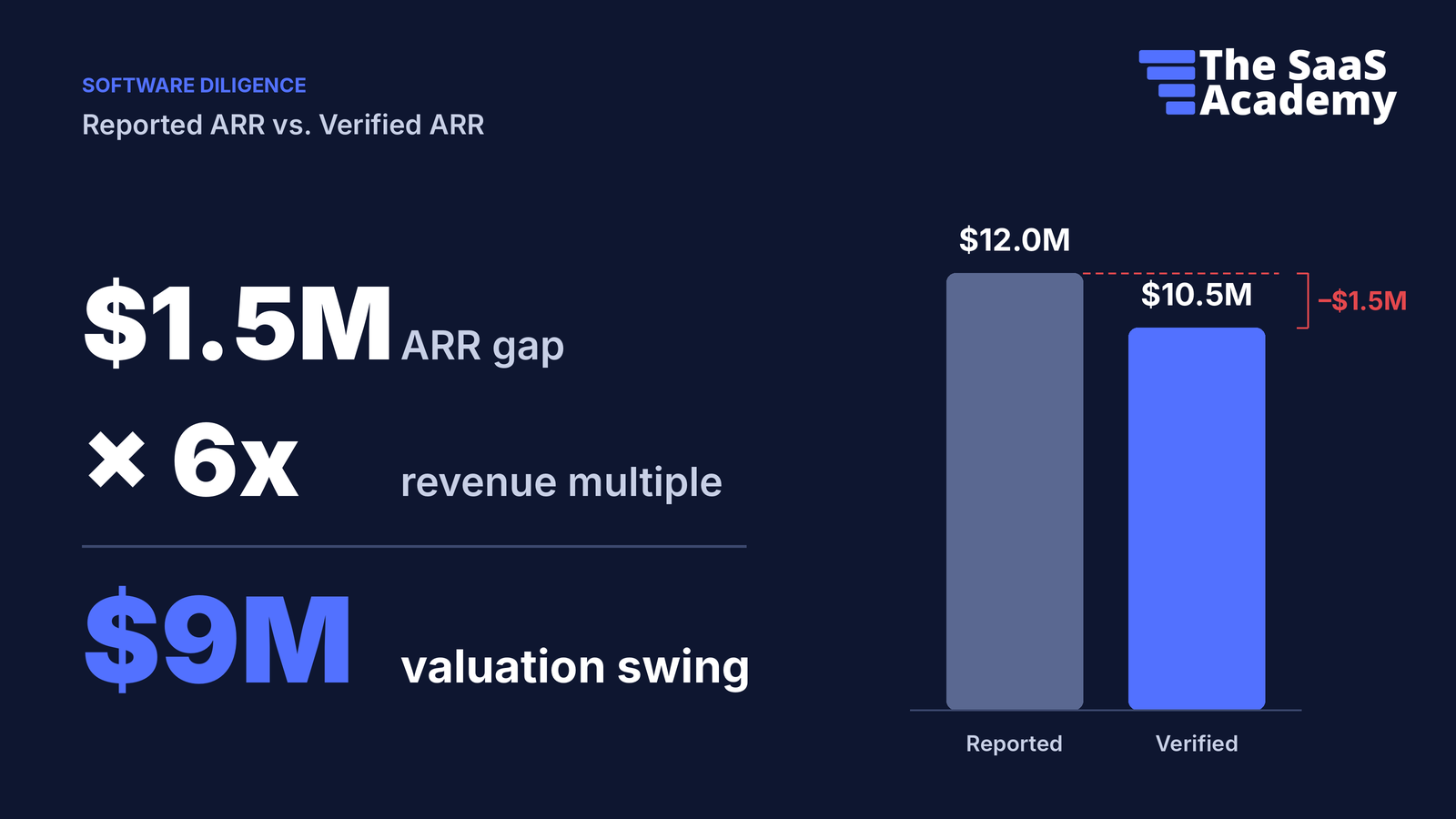
The gap between the ARR reported in a CIM and the verified ARR you can actually underwrite is where valuations swing, deals get re-traded, and investment memos either stand up to scrutiny or fall apart. A management team might legitimately believe their ARR is $12M, but after scrubbing the contract data, stripping out one-time fees, and fixing annualization logic, the defensible number might be $10.5M. At a 6x revenue multiple, that $1.5M discrepancy is a $9M swing in valuation.
If you are an analyst or associate running point on software diligence, your first major test on a live deal is building the bridge from reported ARR to verified ARR.
Here is exactly how you do it.
The Trap of the CIM ARR
Before you can reconcile the numbers, you must understand why they are inflated in the first place. We can’t assume that the CIM ARR is wrong but can’t assume it’s 100% correct either. This usually isn't malicious fraud. It’s usually the result of poorly structured invoice data and a lack of a SaaS financial data foundation
Founders and bankers often calculate ARR by taking the best recent month of total recognized revenue and multiplying it by 12. This is a run-rate calculation, not an ARR calculation. It inadvertently captures historical spikes, professional services, and non-recurring overages, assuming they will continue indefinitely.
If the target’s SaaS chart of accounts is not structured properly, the target’s ARR number could be a dumpster of revenue types.
Your job is to rebuild the ARR from the ground up, moving line by line through the customer data to prove what revenue is contracted, recurring, and active.
Step 1: Strip Out the Non-Recurring Revenue
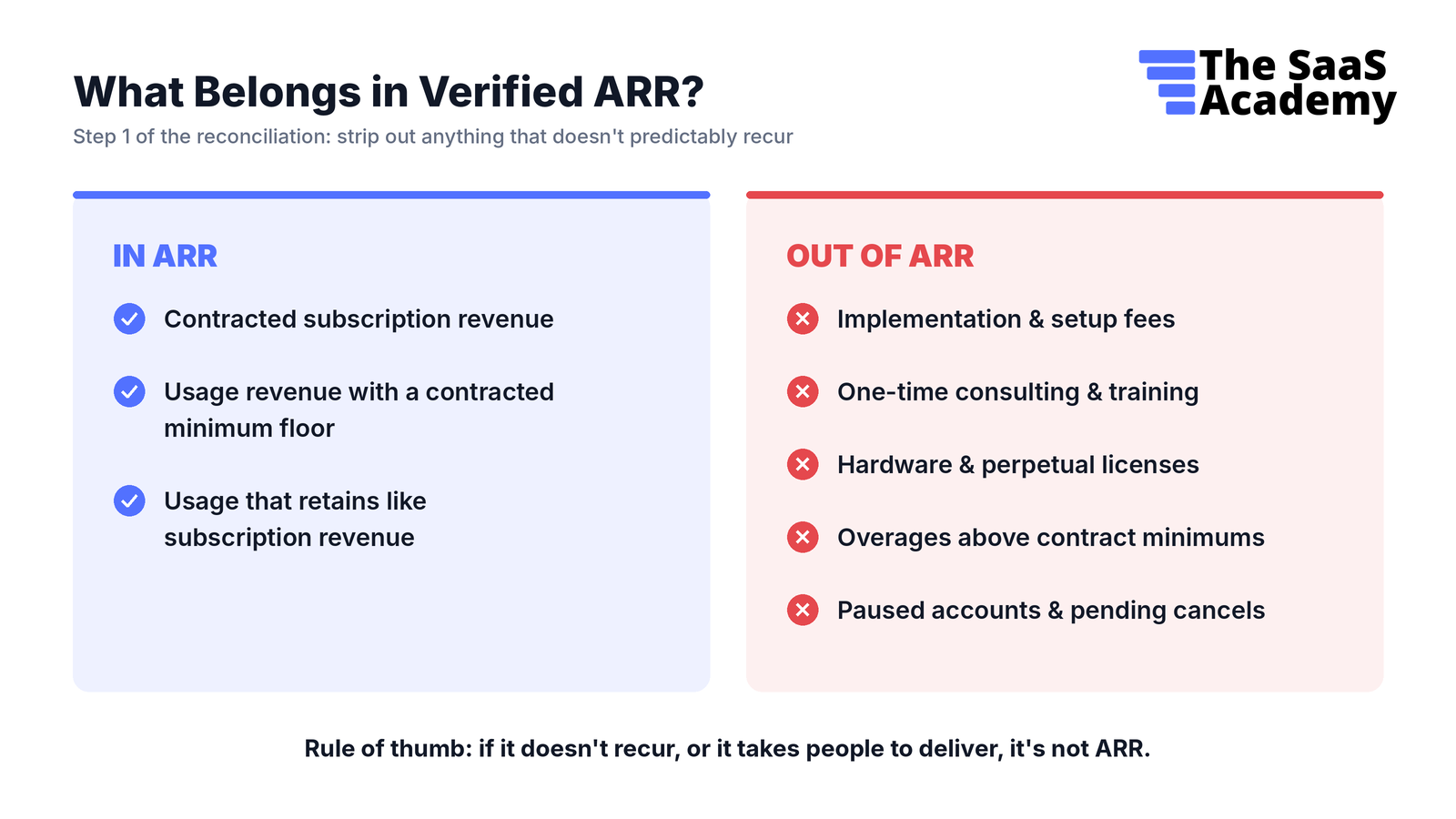
True ARR represents the annualized value of active, predictably recurring subscription and potentially usage contracts. Any revenue that is not recurring in nature and/or that requires people to deliver revenue should be stripped out of ARR.
To start your reconciliation, you need a raw customer-level export from the billing system or CRM. This often called the customer cube. Your first pass is surgical removal. You must identify and deduct:
- Implementation and Setup Fees: Even if they are billed monthly over the first year, onboarding fees are a one-time event. They do not recur in Year 2. They must be stripped out of the ARR baseline and modeled separately as professional services revenue.
- One-Time Consulting and Training: High-touch services often mask a software product's lack of out-of-the-box utility. Strip these out to see the true software revenue.
- Hardware or Perpetual Licenses: If the company bundles hardware (like point-of-sale terminals or IoT sensors) with the software, isolate the software subscription.
- Variable Usage / Overages: If a customer is on a $1,000/month base contract but spent $1,500 last month due to API overages, the ARR is $12,000, not $18,000. The target should not co-mingle overage revenue with subscription or usage revenue streams. You cannot underwrite variable usage as fixed recurring revenue unless there is a contracted minimum floor. Or its retention patterns act like subscription revenue. Dig deep into variable revenue.
Step 2: Challenge the Annualization Logic
Once you have isolated the pure software and usage revenue, you have to look at the math used to annualize it. Management teams often apply aggressive annualization logic to make the ARR look larger. You need to standardize it.
- The MRR Multiplier: If a customer is on a true month-to-month contract, multiplying their MRR by 12 is standard practice. However, if that customer has already submitted a cancellation notice but hasn't churned yet, management will often leave them in the ARR.
- The Usage Multiplier: Take a cue from public tech companies who annualize usage revenue by multiplying the trailing 3 months by 4. However, if the usage revenue is seasonal or cyclical, you may need to use longer periods.
- Mid-Month Starts and Proration: A customer signs on the 15th of the month. Management might annualize the prorated half-month invoice. You need to look at the contracted annual value, not the cash invoice value.
- Free Months and Concessions: If a sales rep closed a $120,000 deal by giving the first two months free, the cash collected in Year 1 is only $100,000. Is the ARR $120k or $100k? You need to standardize how you treat discounts so you don't overstate the near-term cash generation of the business. Was it $120,000 spread over 14 months? Or was it two months free and then the $120K of ARR kicked in?
- Paused Accounts: Customers put "on hold" but not explicitly churned are a classic management hiding spot. If they aren't paying right now, they aren't in your verified ARR.
Step 3: Build the ARR Bridge
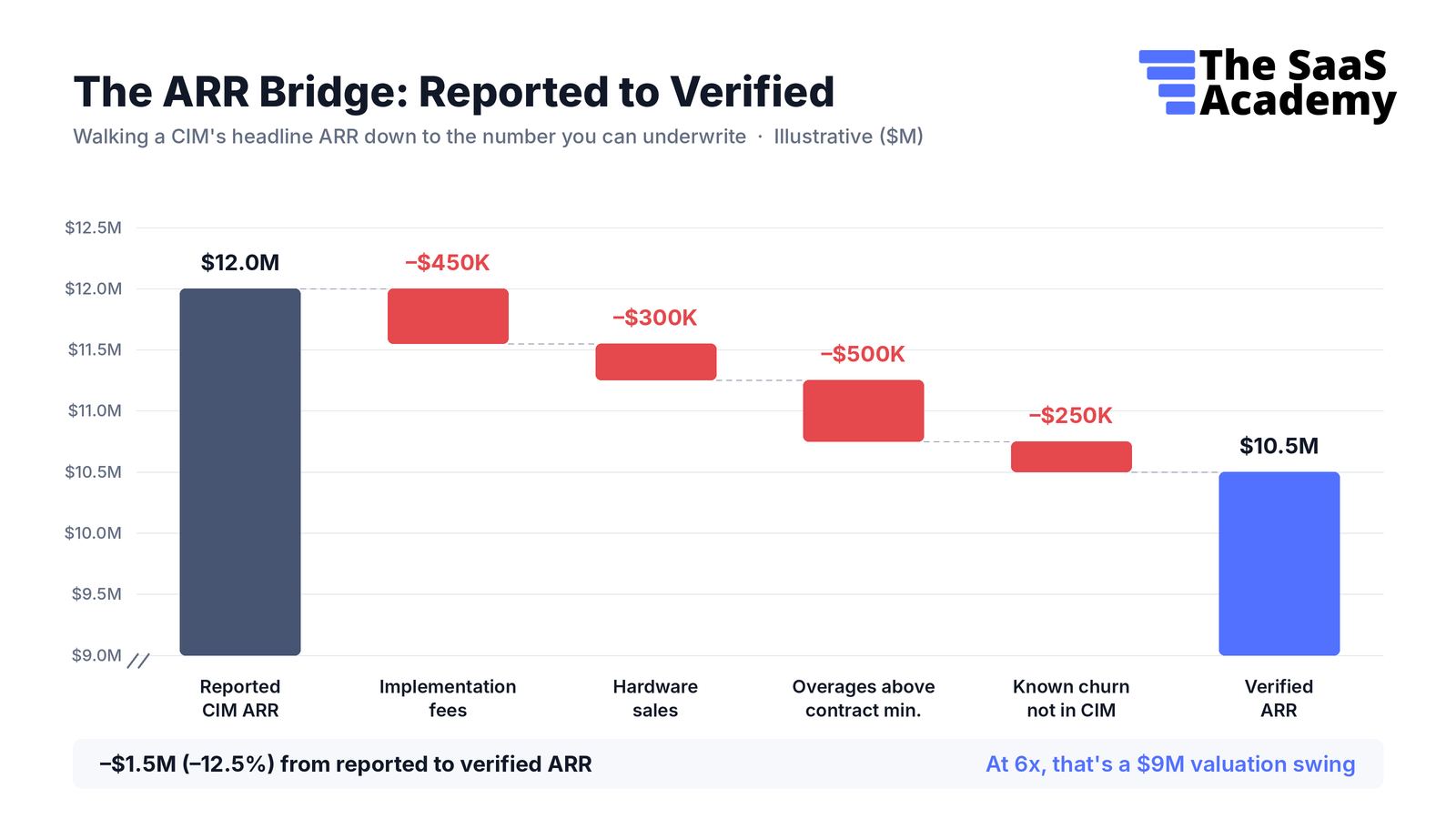
You need invoice data and/or MRR schedules to build the ARR reconciliation bridge. This is a mandatory exhibit in your investment memo and the exact file you will hand to the Quality of Earnings (QoE) provider to guide their financial diligence.
Your bridge should visually and mathematically walk down the numbers:
|
Reported CIM ARR: |
e.g., $12,000,000 |
|
Less: Implementation Fees Annualized |
-$450,000 |
|
Less: Hardware Sales Annualized |
-$300,000 |
|
Less: Variable Overages above Contract Minimums |
-$500,000 |
|
Less: Known Churn not reflected in CIM |
-$250,000 |
|
Underwritten Verified ARR: |
$10,500,000 |
The Investor Interpretation: Why This Matters
As an analyst, you aren't just checking math; you are looking for the "So What?" of the deal. The difference between reported and verified ARR impacts the transaction at multiple levels.
First, Valuation. If the deal is priced on a multiple of ARR, a $1.5M downward adjustment to the ARR baseline gives your deal team the leverage to either renegotiate the purchase price or walk away from an overpriced asset.
Second, Quality of Earnings (QoE) prep. The QoE firm is going to look at GAAP revenue and EBITDA. By doing this ARR reconciliation early, you map the difference between the SaaS metrics (ARR) and the financial accounting (GAAP revenue). You tell the QoE team exactly where the revenue quality issues are hiding before they start billing by the hour.
Third, Cohort and Retention Analysis. You cannot calculate accurate Net Revenue Retention (NRR) or Gross Revenue Retention (GRR) using dirty MRR data. If your ARR includes one-time implementation fees, your retention numbers will artificially crash in Year 2 when those fees don't renew, making the product look leakier than it actually is.
Reconciling ARR is not administrative work. It is the foundation of the software investment thesis.
Want to Build This Exact Bridge on a Real Software Deal?
Software Investing Foundations is a deal simulation training program for software finance professionals. You will open a data room, read the CIM, build the 24-month ARR bridge, rebuild SaaSified margins, and draft a defensible Investment Committee memo.
